
Why Most Drug Programs Fail Before They Are Stopped
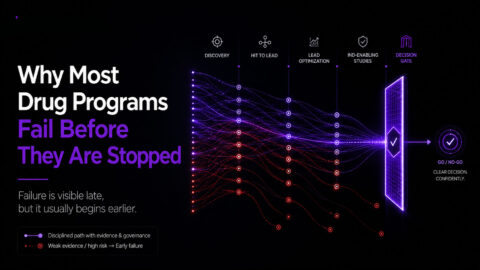
Failure is visible late, but it usually begins earlier.
Drug discovery failure rarely begins at the moment a program is officially stopped.
By the time failure becomes visible, the program has often already consumed years of effort, vendor work, experiments, management attention, and capital. The deeper problem usually began much earlier; when unresolved uncertainty was allowed to move forward as if it were proof.
At OmicsX, we see this as a decision problem.
Programs often do not fail only because teams lacked data. They fail because targets, molecules, modalities, or execution paths were allowed to advance before the evidence was ready.
Failure is often invisible at first
Early failure rarely announces itself clearly.
It usually appears as progress:
- a target still looks promising
- a molecule still has activity
- a vendor is still generating data
- a modality still appears feasible
- a board deck still tells a compelling story
But underneath that activity, the core decision may remain unresolved.
The target may not be sufficiently permissioned.
The molecule may not have earned progression.
The modality may not fit the biological constraints.
The vendor output may not be decision-useful.
The funding decision may be based on confidence rather than proof.
This is how weak programs survive too long.
The wrong response is often more data
When uncertainty appears, many organizations respond by asking for more data.
More assays.
More vendor work.
More reports.
More analysis.
More dashboards.
But more data does not automatically create a better decision.
If the decision point is not clearly defined, and if the evidence standard is not governed, additional data can increase complexity without improving clarity.
The real question is not:
“Do we have more information?”
The real question is:
“Is the available evidence strong enough to justify progression?”
That is a different question.
The failure is decisional
Many weak programs continue because no system forces an earlier decision.
Biology is treated as sufficient before it is tested.
Feasibility is assumed before constraints are exposed.
Vendor activity is mistaken for execution proof.
Molecules continue because stopping them is uncomfortable.
Capital is allocated because the narrative remains attractive.
This creates a hidden failure pattern:
Programs keep moving because nothing has forced them to stop.
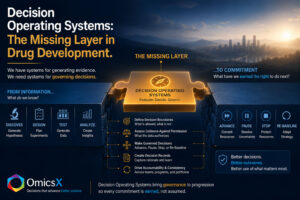
That is why OmicsX frames drug development around governed decisions, not just intelligence.
What governed decisions change
A governed decision system changes the question from:
“Can we keep going?”
to:
“Has this earned permission to move forward?”
That shift matters.
Governed decisions define:
- what decision is being made
- what outputs are required
- what evidence can influence progression
- what remains uncertain
- what should pause
- what should stop
- what must be proven next
This prevents weak evidence from carrying expensive decisions.
It also helps teams avoid the most costly form of failure: discovering too late that the program should have been stopped earlier.
Where OmicsX fits
OmicsX builds decision-governance systems for drug discovery.
Our systems are designed to determine what should proceed, pause, stop, become partner-only, or require re-baselining across:
- difficult targets
- molecule sets
- modality choices
- vendor execution
- funding allocation
- board and investor decisions
The goal is not to produce another report.
The goal is to make progression conditional on proof.
Final Thought
Most programs do not fail only at the end.
Many fail earlier – when weak evidence is allowed to keep moving forward.
If progression required proof, more weak programs would stop before capital, execution, and narrative pressure compound risk.
That is why governed decisions matter.