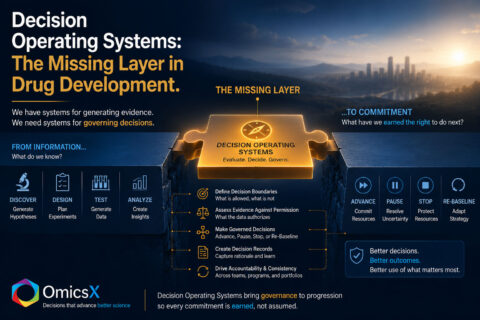
Decision Operating Systems: the missing layer in drug development.
Drug development has built extraordinary systems for generating evidence. It has rarely built systems for governing what that evidence permits. That gap is where programmes fail.
Over the last decade, drug development has become extraordinarily sophisticated at generating information.
EXISTS
Systems for Discovering Targets
EXISTS
Systems for Designing Molecules
EXISTS
Systems for Discovering Targets
EXISTS
Systems for Discovering Targets
EXISTS
Systems for Discovering Targets
EXISTS
Systems for Discovering Targets
EXISTS
Systems for Discovering Targets
EXISTS
Systems for Discovering Targets
Yet despite this sophistication, one critically important question often remains unanswered:
“Who governs the decision itself? Not the experiment. Not the report. Not the meeting. The decision.”
Where the gap lives
Drug development does not advance through information alone. It advances through commitments.
A target progresses. A molecule advances. A modality receives funding. A CRO is engaged. A board authorises the next tranche of capital.
Each of these represents a decision. Each commits resources. Each changes the future direction of the programme.
Yet in most organisations, those decisions emerge through a combination of scientific enthusiasm, strategic optimism, executive judgement, historical investment, and portfolio pressure.
Sometimes those factors align with evidence. Sometimes they do not.
The challenge is not that organisations lack intelligence. The challenge is that they lack a structured operating layer between evidence and commitment.
Without that layer, nobody explicitly defines what has been established, what remains uncertain, what permission has been earned, what commitment remains prohibited, or what evidence would justify a stop.
Progression slowly becomes an assumption rather than a governed outcome.
The environment progression decisions live inside
Progression decisions do not happen in neutral conditions. They happen inside environments of optimism, sunk cost, strategic pressure, scientific excitement, timeline commitments, investor expectations, and organisational momentum.
When those forces accumulate, continuation becomes the default. Not because the evidence is sufficient. Because the organization has no structured mechanism for determining when evidence becomes permission.
“More information can create more confidence without creating more certainty. Confidence supports a narrative. Certainty requires evidence.”
The industry often assumes that better information leads to better decisions. Sometimes it does. Sometimes it creates more sophisticated reasons to continue investing in programs that have not yet earned continuation.
What is actually at stake
What organizations have systems for
- How experiments are conducted
- How vendors deliver work
- How studies are executed
- How resources are allocated
- How portfolios are reviewed
What rarely has a system
- When evidence becomes permission
- What blocks progression
- Who owns the decision
- What record explains the verdict
- When to pause, stop, or re-baseline
Every meaningful progression decision consumes resources that cannot easily be recovered: capital, time, organisational attention, vendor capacity, scientific opportunity, strategic flexibility.
Before those resources are committed, organisations should be able to answer one simple question:
What specific evidence has earned the right to proceed? Not what do we believe. Not what do we hope. Not what have we already invested. What has been sufficiently established to justify the next commitment?
Where the industry is heading
Drug development will not be differentiated in the future solely by the ability to generate information. Platforms for generating data, hypotheses, and predictions are proliferating rapidly. The gap is not information volume.
The companies that create the greatest value may not be those that run the most experiments. They may be those that most effectively distinguish between activity and permission.
In drug development, success is rarely determined by the volume of work performed.
It is determined by the quality of the decisions that determine what work deserves to continue.
For leaders across R&D, BD, portfolio strategy, and investment governance:
How does your organization currently determine when evidence becomes permission?
And who owns that decision?