

Why Strong Data Does Not Automatically Earn Commitment
Evidence and Commitment are not the same thing. One of the most costly confusions in drug development.
Drug development is built on evidence. Experiments generate data. Studies generate findings. And the assumption seems straightforward:
If the data is strong, the programme should move forward.
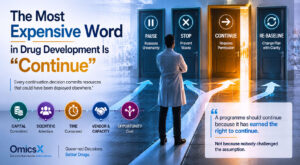
Yet some of the most expensive mistakes in drug development occur precisely here — when organisations confuse strong data with progression permission.
The two are not the same thing.
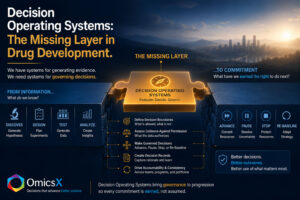
Strong data answers one question: “What have we learned?”
Commitment requires a different question: “What have we earned the right to do next?”
Those questions sound similar. They are fundamentally different. One concerns knowledge. The other concerns commitment.
What data answers
"What have we learned?"
Concerns knowledge. Belongs to science.
What commitment requires
"What have we earned the right to do next?"Concerns commitment. Belongs to decision-making.
How decision drift happens
Strong data creates confidence. Confidence is valuable. But confidence is not permission.
A programme can inspire confidence while still carrying critical unresolved uncertainties. A molecule can demonstrate activity while still lacking progression readiness. A modality can generate excitement while still lacking the evidence necessary for commitment.
The challenge is not whether the data is good. The challenge is whether the data is sufficient for the decision being requested.
Here is how assumption replaces evidence:
A positive result appears. A milestone is achieved. An expert expresses support.
The conversation shifts from “Should we advance?” to “When do we advance?”
Progression is assumed rather than earned. The organisation has moved from evidence review to expectation management.
Data is visible. Uncertainty is not. Teams can present results and show charts. It is much harder to present what remains unknown – yet unresolved uncertainty often determines whether commitment is appropriate, not the strength of the evidence alone.
The shift that protects programmes
The most important shift organisations can make is moving from a culture of evidence accumulation to a culture of permission clarity.
Not: “How much data do we have?” — But: “What decision does this evidence actually support?”
Not: “Is this finding encouraging?” — But: “What commitment has this finding earned?”
Those questions often produce very different answers.
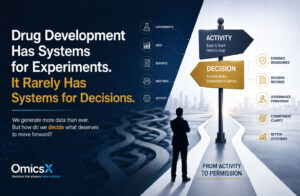
Drug development does not suffer from a shortage of information. It suffers from a shortage of clarity about what information authorises.
Commitment is not a reward for strong data. Commitment is a decision about future resource allocation.
Evidence creates knowledge. Permission creates progression.
Confusing the two is one of the most expensive mistakes an organisation can make.
For R&D Leaders and Portfolio Teams:
Does your organisation have a formal mechanism for distinguishing what the data shows from what the data authorises? What does that process look like in practice? Share in the comments.