Decision Operating Systems: The Missing Layer in Drug Development

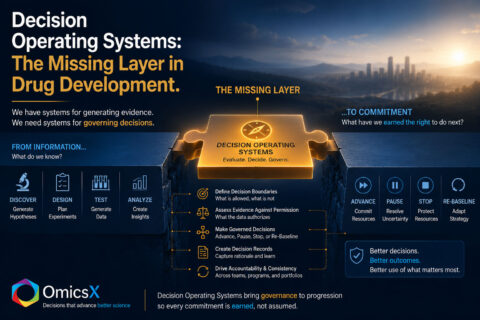
Decision Operating Systems: the missing layer in drug development.

Drug development has built extraordinary systems for generating evidence. It has rarely built systems for governing what that evidence permits. That gap is where programmes fail.

Over the last decade, drug development has become extraordinarily sophisticated at generating information.

EXISTS

Systems for Discovering Targets

EXISTS

Systems for Designing Molecules

EXISTS

Systems for Discovering Targets

EXISTS

Systems for Discovering Targets

EXISTS

Systems for Discovering Targets

EXISTS

Systems for Discovering Targets

EXISTS

Systems for Discovering Targets

EXISTS

Systems for Discovering Targets

Yet despite this sophistication, one critically important question often remains unanswered:
“Who governs the decision itself? Not the experiment. Not the report. Not the meeting. The decision.”

Where the gap lives

Drug development does not advance through information alone. It advances through commitments.

A target progresses. A molecule advances. A modality receives funding. A CRO is engaged. A board authorises the next tranche of capital.

Each of these represents a decision. Each commits resources. Each changes the future direction of the programme.

Yet in most organisations, those decisions emerge through a combination of scientific enthusiasm, strategic optimism, executive judgement, historical investment, and portfolio pressure.
Sometimes those factors align with evidence. Sometimes they do not.
The challenge is not that organisations lack intelligence. The challenge is that they lack a structured operating layer between evidence and commitment.

Without that layer, nobody explicitly defines what has been established, what remains uncertain, what permission has been earned, what commitment remains prohibited, or what evidence would justify a stop.

Progression slowly becomes an assumption rather than a governed outcome.

The environment progression decisions live inside

Progression decisions do not happen in neutral conditions. They happen inside environments of optimism, sunk cost, strategic pressure, scientific excitement, timeline commitments, investor expectations, and organisational momentum.

When those forces accumulate, continuation becomes the default. Not because the evidence is sufficient. Because the organization has no structured mechanism for determining when evidence becomes permission.

“More information can create more confidence without creating more certainty. Confidence supports a narrative. Certainty requires evidence.”

The industry often assumes that better information leads to better decisions. Sometimes it does. Sometimes it creates more sophisticated reasons to continue investing in programs that have not yet earned continuation.

What is actually at stake

What organizations have systems for

  • How experiments are conducted
  • How vendors deliver work
  • How studies are executed
  • How resources are allocated
  • How portfolios are reviewed

What rarely has a system

  • When evidence becomes permission
  • What blocks progression
  • Who owns the decision
  • What record explains the verdict
  • When to pause, stop, or re-baseline

Every meaningful progression decision consumes resources that cannot easily be recovered: capital, time, organisational attention, vendor capacity, scientific opportunity, strategic flexibility.

Before those resources are committed, organisations should be able to answer one simple question:

What specific evidence has earned the right to proceed? Not what do we believe. Not what do we hope. Not what have we already invested. What has been sufficiently established to justify the next commitment?

Where the industry is heading

Drug development will not be differentiated in the future solely by the ability to generate information. Platforms for generating data, hypotheses, and predictions are proliferating rapidly. The gap is not information volume.

The companies that create the greatest value may not be those that run the most experiments. They may be those that most effectively distinguish between activity and permission.

In drug development, success is rarely determined by the volume of work performed.

It is determined by the quality of the decisions that determine what work deserves to continue.

For leaders across R&D, BD, portfolio strategy, and investment governance:

How does your organization currently determine when evidence becomes permission?

And who owns that decision?

Why Strong Data Does Not Automatically Earn Commitment

Why Strong Data Does Not  Automatically Earn Commitment

Evidence and Commitment are not the same thing. One of the most costly confusions in drug development.

Drug development is built on evidence. Experiments generate data. Studies generate findings. And the assumption seems straightforward:

If the data is strong, the programme should move forward.

Yet some of the most expensive mistakes in drug development occur precisely here — when organisations confuse strong data with progression permission.

The two are not the same thing.

Strong data answers one question: “What have we learned?”

Commitment requires a different question: “What have we earned the right to do next?”

Those questions sound similar. They are fundamentally different. One concerns knowledge. The other concerns commitment.

What data answers

"What have we learned?"
Concerns knowledge. Belongs to science.

What commitment requires

"What have we earned the right to do next?"Concerns commitment. Belongs to decision-making.

How decision drift happens

Strong data creates confidence. Confidence is valuable. But confidence is not permission.

A programme can inspire confidence while still carrying critical unresolved uncertainties. A molecule can demonstrate activity while still lacking progression readiness. A modality can generate excitement while still lacking the evidence necessary for commitment.

The challenge is not whether the data is good. The challenge is whether the data is sufficient for the decision being requested.

Here is how assumption replaces evidence:

A positive result appears. A milestone is achieved. An expert expresses support.

The conversation shifts from “Should we advance?” to “When do we advance?”

Progression is assumed rather than earned. The organisation has moved from evidence review to expectation management.

Data is visible. Uncertainty is not. Teams can present results and show charts. It is much harder to present what remains unknown – yet unresolved uncertainty often determines whether commitment is appropriate, not the strength of the evidence alone.

The shift that protects programmes

The most important shift organisations can make is moving from a culture of evidence accumulation to a culture of permission clarity.

Not: “How much data do we have?” — But: “What decision does this evidence actually support?”

Not: “Is this finding encouraging?” — But: “What commitment has this finding earned?”

Those questions often produce very different answers.

Drug development does not suffer from a shortage of information. It suffers from a shortage of clarity about what information authorises.

Commitment is not a reward for strong data. Commitment is a decision about future resource allocation.

Evidence creates knowledge. Permission creates progression.

Confusing the two is one of the most expensive mistakes an organisation can make.

For R&D Leaders and Portfolio Teams:

Does your organisation have a formal mechanism for distinguishing what the data shows from what the data authorises? What does that process look like in practice? Share in the comments.

The Most Expensive Word in Drug Development Is “Continue”

The Most Expensive Word in Drug Development Is  "Continue"

The industry spends enormous effort analysing failure.
It rarely governs the decisions that create it.

Drug development teams spend enormous time discussing failure.

Clinical failure. Scientific failure. Regulatory failure. Commercial failure.

Yet some of the most expensive decisions in drug development are not failures at all.

“Continue.”

The decision to continue often feels harmless. A programme remains active. Another study is commissioned. More vendor work is approved. The next tranche of capital is released. The team agrees that more evidence will provide greater clarity.

Nobody considers that moment particularly risky.

Yet that decision may ultimately become one of the most expensive choices the organisation makes.

“Failure is visible. Continuation is usually invisible, and that invisibility is precisely what makes it dangerous.”

Why continuation escapes scrutiny

When a programme fails
- Resources consumed are visible.
- Time lost is documented.
- Strategic objective is unmet.
- Organization recognizes the outcome.

When a programme continues
- Programme appears alive.
- Progress appears to be occurring.
- Milestones continue to be generated.
- Underlying decision goes unquestioned.

Many programmes do not fail because they were started. They fail because they were allowed to continue beyond the point where meaningful permission existed.

Starting a programme is often based on a hypothesis. Continuing a programme should be based on evidence. Yet organisations frequently treat continuation as the default outcome rather than a decision that must be earned.

What every continuation consumes

Development Capital

Scientific Attention

Leadership Bandwidth

Vendor Capacity

Portfolio Flexibility

Opportunity Cost

None of these can be recovered simply because the programme remained active.

The governance illusion

One of the most important challenges is that continuation rarely feels like a decision.

Stopping feels like a decision. Pausing feels like a decision. Cancelling feels like a decision.

Continuation often feels like the absence of a decision. The programme simply proceeds. The next activity begins. The next study is funded.

What appears to be a neutral choice is actually a significant commitment of organisational resources. The decision has been made. It simply has not been recognised as one.

This is particularly common in programmes showing partial success. A target appears biologically interesting. A molecule demonstrates encouraging activity. A modality produces an early signal.

None of these observations necessarily establish progression permission. They establish potential.

Potential creates reasons to explore. Permission creates reasons to commit. Many organisations unintentionally confuse the two.

The accumulation trap

The longer a programme continues, the more difficult objective decision-making becomes. Investment accumulates. Teams become attached. Timelines become visible. External expectations increase. Narratives become stronger.

At some point, continuation begins to justify itself. The programme continues because it has already continued.

This is one of the most expensive dynamics in drug development. Not because the science is wrong. Because the governance becomes weak.

What strong organizations ask before committing

Before releasing the next tranche – six questions worth asking

These questions do not slow development. They improve the quality of commitment. The goal of governance is not to stop programmes. It is to ensure that continuation remains intentional.

A programme should continue because it has earned the right to continue. Not because nobody has challenged the assumption. Not because the next experiment is already planned. Not because the organisation is uncomfortable making a different decision.

Drug development will always involve uncertainty. No governance framework eliminates risk.

But organisations can improve the quality of decisions made under uncertainty, and that begins with recognising a simple reality.

The most expensive word in drug development is often not “failure.” It is “continue.” Because every continuation commits resources that could have been deployed elsewhere. And every programme that moves forward should be able to answer one fundamental question:

What evidence has earned the right for this programme to continue?

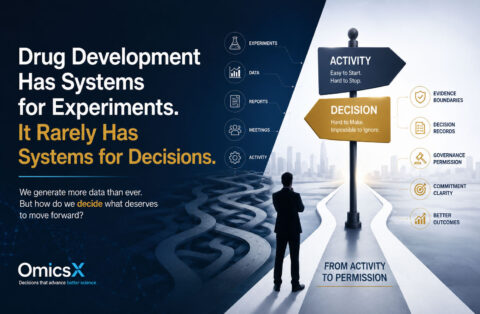
Drug development has systems for experiments.
It rarely has systems for decisions.

Drug development has systems for experiments. It rarely has systems for decisions.

Why the Industry that governs everything else leaves its most expensive decisions ungoverned.

We have built remarkable systems for running experiments.

Target discovery platforms. Screening systems. Preclinical frameworks. Clinical plans. Regulatory pathways. Vendor ecosystems. Data lakes. AI tools.

Every one of these systems governs something; how an experiment is conducted, how external work is delivered, how a study is executed, how resources are allocated.

“But what governs the decision to proceed? What governs the decision to pause? What governs the decision to stop?”

In most organisations, those decisions emerge through discussion. Through meetings. Through accumulated confidence.

Not through governance.

Why this matters now

Consider a situation most R&D leaders will recognize immediately.

Early signalsEncouraging evidence from the target.

Molecule statusSeveral candidates appear promising

External viewExpert opinion is supportive

Internal stateTeam is enthusiastic, capital is available

At this point, most organisations have systems capable of generating more information. What they often lack is a system capable of determining whether the programme has actually earned the right to advance.

That distinction is not a philosophical one. It is an operational one, and it carries real financial consequence.

The environment progression decisions live inside

Progression decisions do not happen in neutral conditions. They happen inside environments of optimism, sunk cost, strategic pressure, scientific excitement, timeline commitments, investor expectations, and organisational momentum.

When those forces accumulate, continuation becomes the default. Not because the evidence is sufficient. Because the organization has no structured mechanism for determining when evidence becomes permission.

“More information can create more confidence without creating more certainty. Confidence supports a narrative. Certainty requires evidence.”

The industry often assumes that better information leads to better decisions. Sometimes it does. Sometimes it creates more sophisticated reasons to continue investing in programs that have not yet earned continuation.

What is actually at stake

What organizations have systems for

  • How experiments are conducted
  • How vendors deliver work
  • How studies are executed
  • How resources are allocated
  • How portfolios are reviewed

What rarely has a system

  • When evidence becomes permission
  • What blocks progression
  • Who owns the decision
  • What record explains the verdict
  • When to pause, stop, or re-baseline

Every meaningful progression decision consumes resources that cannot easily be recovered: capital, time, organisational attention, vendor capacity, scientific opportunity, strategic flexibility.

Before those resources are committed, organisations should be able to answer one simple question:

What specific evidence has earned the right to proceed? Not what do we believe. Not what do we hope. Not what have we already invested. What has been sufficiently established to justify the next commitment?

Where the industry is heading

Drug development will not be differentiated in the future solely by the ability to generate information. Platforms for generating data, hypotheses, and predictions are proliferating rapidly. The gap is not information volume.

The companies that create the greatest value may not be those that run the most experiments. They may be those that most effectively distinguish between activity and permission.

In drug development, success is rarely determined by the volume of work performed.

It is determined by the quality of the decisions that determine what work deserves to continue.

For leaders across R&D, BD, portfolio strategy, and investment governance:

How does your organization currently determine when evidence becomes permission?

And who owns that decision?