

The Most Expensive Word in Drug Development Is "Continue"
The industry spends enormous effort analysing failure.
It rarely governs the decisions that create it.
Drug development teams spend enormous time discussing failure.
Clinical failure. Scientific failure. Regulatory failure. Commercial failure.
Yet some of the most expensive decisions in drug development are not failures at all.
“Continue.”
The decision to continue often feels harmless. A programme remains active. Another study is commissioned. More vendor work is approved. The next tranche of capital is released. The team agrees that more evidence will provide greater clarity.
Nobody considers that moment particularly risky.
Yet that decision may ultimately become one of the most expensive choices the organisation makes.
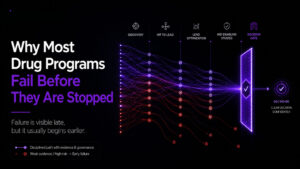
“Failure is visible. Continuation is usually invisible, and that invisibility is precisely what makes it dangerous.”
Why continuation escapes scrutiny
When a programme fails
- Resources consumed are visible.
- Time lost is documented.
- Strategic objective is unmet.
- Organization recognizes the outcome.
When a programme continues
- Programme appears alive.
- Progress appears to be occurring.
- Milestones continue to be generated.
- Underlying decision goes unquestioned.
Many programmes do not fail because they were started. They fail because they were allowed to continue beyond the point where meaningful permission existed.
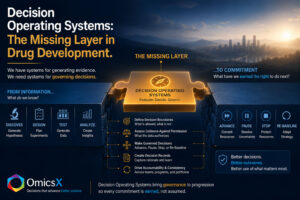
Starting a programme is often based on a hypothesis. Continuing a programme should be based on evidence. Yet organisations frequently treat continuation as the default outcome rather than a decision that must be earned.
What every continuation consumes
Development Capital
Scientific Attention
Leadership Bandwidth
Vendor Capacity
Portfolio Flexibility
Opportunity Cost
None of these can be recovered simply because the programme remained active.
The governance illusion
One of the most important challenges is that continuation rarely feels like a decision.
Stopping feels like a decision. Pausing feels like a decision. Cancelling feels like a decision.
Continuation often feels like the absence of a decision. The programme simply proceeds. The next activity begins. The next study is funded.
What appears to be a neutral choice is actually a significant commitment of organisational resources. The decision has been made. It simply has not been recognised as one.
This is particularly common in programmes showing partial success. A target appears biologically interesting. A molecule demonstrates encouraging activity. A modality produces an early signal.
None of these observations necessarily establish progression permission. They establish potential.
Potential creates reasons to explore. Permission creates reasons to commit. Many organisations unintentionally confuse the two.
The accumulation trap
The longer a programme continues, the more difficult objective decision-making becomes. Investment accumulates. Teams become attached. Timelines become visible. External expectations increase. Narratives become stronger.
At some point, continuation begins to justify itself. The programme continues because it has already continued.
This is one of the most expensive dynamics in drug development. Not because the science is wrong. Because the governance becomes weak.
What strong organizations ask before committing
Before releasing the next tranche – six questions worth asking
- What specific evidence has been established since the last review ?
- What uncertainty remains unresolved - and is it acceptable ?
- What new permission has been earned to justify this commitment?
- What outcome would justify a pause at this stage?
- What outcome would justify a stop?
- What outcome would justify full progression - and has it been met?
These questions do not slow development. They improve the quality of commitment. The goal of governance is not to stop programmes. It is to ensure that continuation remains intentional.
A programme should continue because it has earned the right to continue. Not because nobody has challenged the assumption. Not because the next experiment is already planned. Not because the organisation is uncomfortable making a different decision.
Drug development will always involve uncertainty. No governance framework eliminates risk.
But organisations can improve the quality of decisions made under uncertainty, and that begins with recognising a simple reality.
The most expensive word in drug development is often not “failure.” It is “continue.” Because every continuation commits resources that could have been deployed elsewhere. And every programme that moves forward should be able to answer one fundamental question:
What evidence has earned the right for this programme to continue?